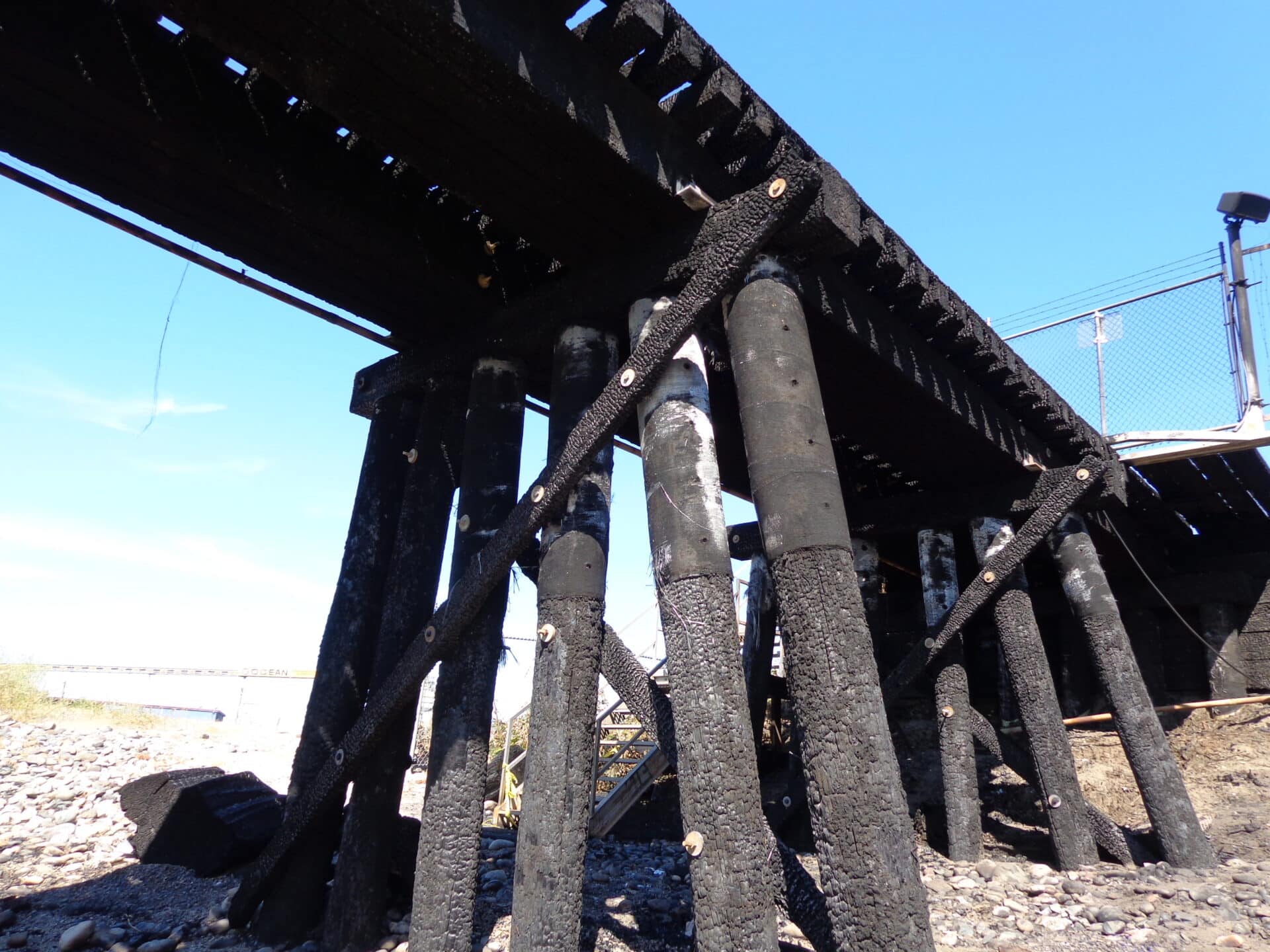
After a fire, the structure usually gets written off before anyone measures anything. The timber is black, the smell is in everything, and the assumption follows on its own: it burned, so it is gone.
That assumption is wrong often enough to be worth checking. A charred timber girder is not a failed timber girder. Char is a layer with a measurable depth, and underneath it sits sound timber that in many cases still carries the load it was designed for. Whether a structure is recoverable is a question you answer with a tape and a drill, not with a glance.
Here is what a fire actually does to heavy timber, and how the remaining capacity gets established.
Big timber sections are hard to burn
Anyone who has tried to light a campfire knows the problem. Kindling catches instantly. A split log takes effort. A whole log, green in the middle, will sit in the flames and refuse.
The same physics applies at structural scale, and it is the reason heavy timber has been treated differently from light framing in building codes for more than a century. When a large solid section is exposed to fire, the outer surface pyrolyzes and forms a char layer. That layer is around one fifth the density of the parent timber and a poor conductor of heat. It insulates the wood behind it, slowing the rate at which the fire can reach fresh material. The section burns inward at a rate that is slow, steady, and predictable enough to design around.
Steel does not do this. Design codes treat roughly 538 degrees Celsius as steel’s limiting temperature, the point at which it retains about two thirds of its room temperature yield strength, and by 600 degrees it has lost about half. None of that loss is visible from the outside. Concrete spalls, and where it spalls it exposes reinforcement that is then heated directly. Neither material fails gracefully, and neither leaves a record of how much it gave up. Timber chars at a known rate and writes the evidence on the member.
The char rate is a number, not an estimate
This is the part that surprises people who have not worked with the fire design provisions. The rate at which timber chars under standard fire exposure is a published design value.
The American Wood Council’s National Design Specification gives a nominal char rate of 1.5 inches per hour, about 38 millimeters per hour, for sawn lumber, glulam, laminated veneer lumber, parallel strand lumber and laminated strand lumber. Design calculations then add roughly twenty percent to the char depth to account for the heat-affected zone immediately behind the char, where the timber is intact but temporarily weakened. Call it 45 millimeters of effective section loss per exposed face, per hour.
Run that on a real member. Take a 400 by 400 millimeter girder exposed on all four faces for a full hour of standard fire. You lose about 45 millimeters from each side, leaving a residual section a little over 300 millimeters square. Section modulus falls to roughly 46 percent of the original. Reduced, plainly. But a beam retaining close to half its bending capacity after sixty minutes in a fire is not a beam that has failed, and the char method in the same specification is used to demonstrate fire resistance ratings up to two hours.
The practical consequence is that oversizing a timber member is a fire strategy. Add section, add time.
Three building codes have already accepted this
None of the above is a position Wood Research and Development holds on its own. It is the basis on which three national codes rewrote their rules inside the last few years.
In the United States, the International Code Council’s Tall Wood Building committee put fourteen proposals through the code development process, all of which were approved in 2019 and landed in the 2021 International Building Code. They created three new construction types. Type IV-A permits mass timber buildings up to 18 stories with all timber elements protected by noncombustible material. Type IV-B permits 12 stories with limited timber left exposed. Type IV-C permits 9.
In Canada, the 2020 National Building Code introduced encapsulated mass timber construction as a distinct construction type, permitting buildings up to 12 stories with the uppermost floor no more than 42 meters above the first. Every element requires a two hour fire resistance rating, the building must be sprinklered throughout, and encapsulation materials are qualified against the ULC S146 test.
Australia’s National Construction Code carries its own provisions for massive timber and fire protected timber systems.
Three jurisdictions, three sets of regulators with no commercial interest in the outcome, all arriving at the same conclusion after full-scale compartment fire testing. Several of those test compartments self-extinguished without intervention once the fuel load was consumed.
Cross-laminated timber behaves slightly differently
One caveat worth knowing, because it gets missed. Cross-laminated timber does not char in a straight line the way a solid or glue-laminated section does.
CLT is built from layers, and the adhesive between those layers matters under heat. With some adhesives the char layer falls away as the char front reaches a glue line, which briefly exposes fresh timber and accelerates charring until a new protective layer forms. Char rate models for CLT account for this with terms that vary by lamination thickness and exposure time, and current manufacturing standards require heat-resistant adhesives that hold the layers together long enough for the char to stay put.
If you are assessing a CLT element after a fire, the lamination schedule and the adhesive specification are part of the evidence. They are not for a solid girder.
What an assessment actually involves
Char has no residual capacity. Nothing in the black layer is doing structural work, so to measure the section you have to get past it. That does not mean the char has to be stripped off the finished structure, and on a member that still carries its load there are good reasons to leave it. For the purposes of assessment, though, the question is what sits underneath, and that is a measurement exercise.
The sequence is straightforward. Establish the likely fire exposure and duration from the incident record. Remove the char and measure how deep it went, face by face, member by member, because exposure is never uniform in a real fire. Take the residual dimensions. Discount a further zero-strength layer behind the char front to allow for thermal damage in timber that still looks sound. Recalculate capacity on the section that is left and compare it to the demand.
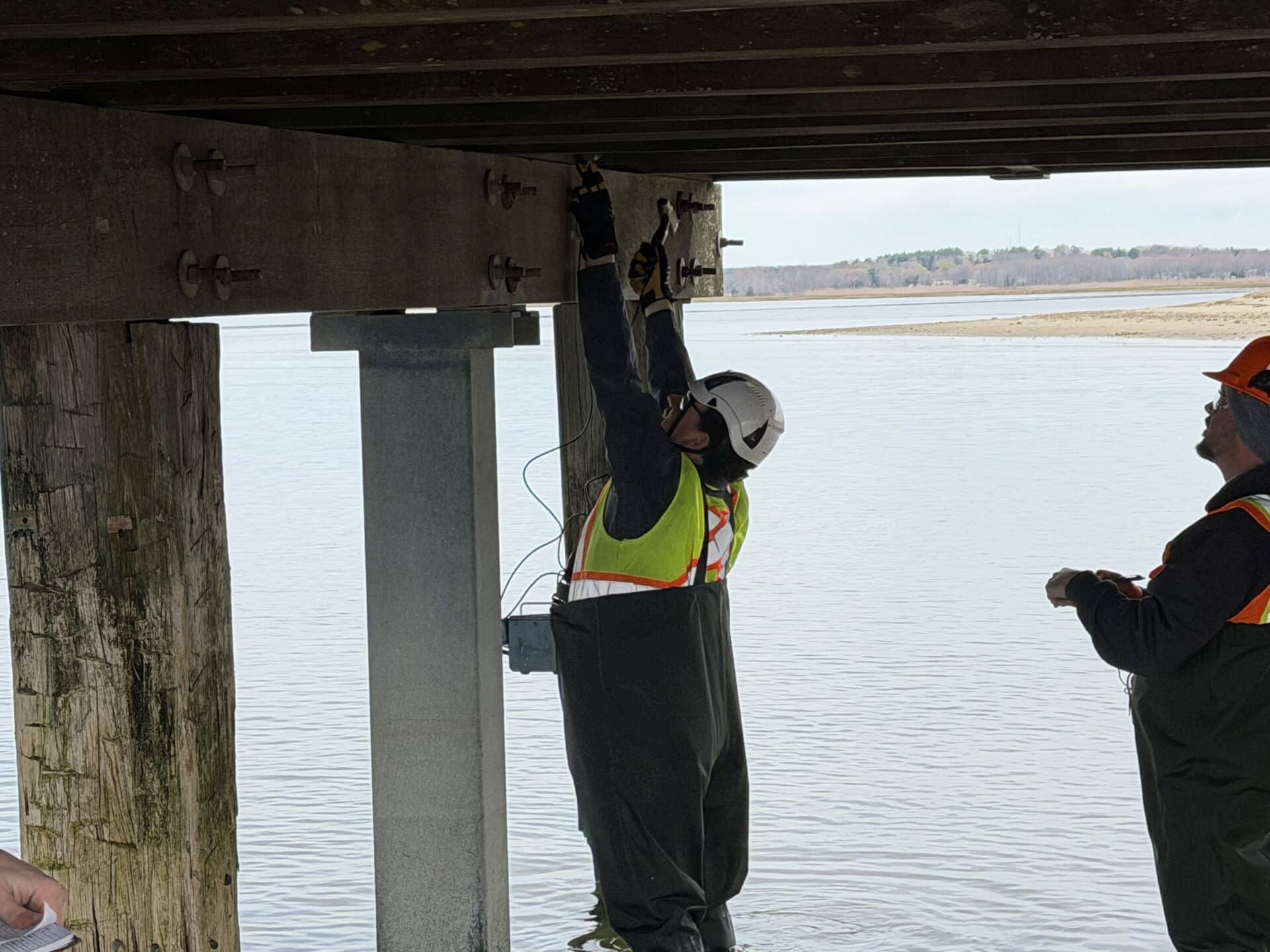
This is where non-destructive testing earns its place. Stress wave timing through the residual section tells you whether heat has degraded timber deeper than the char depth suggests, because a wave slows down where the wood has gone soft. EPHOD® stress-wave testing maps that internally, across a member, without cutting anything. Resistance micro-drilling cross-checks the result at specific depths, and moisture readings show whether a decay mechanism was already running before the fire started.
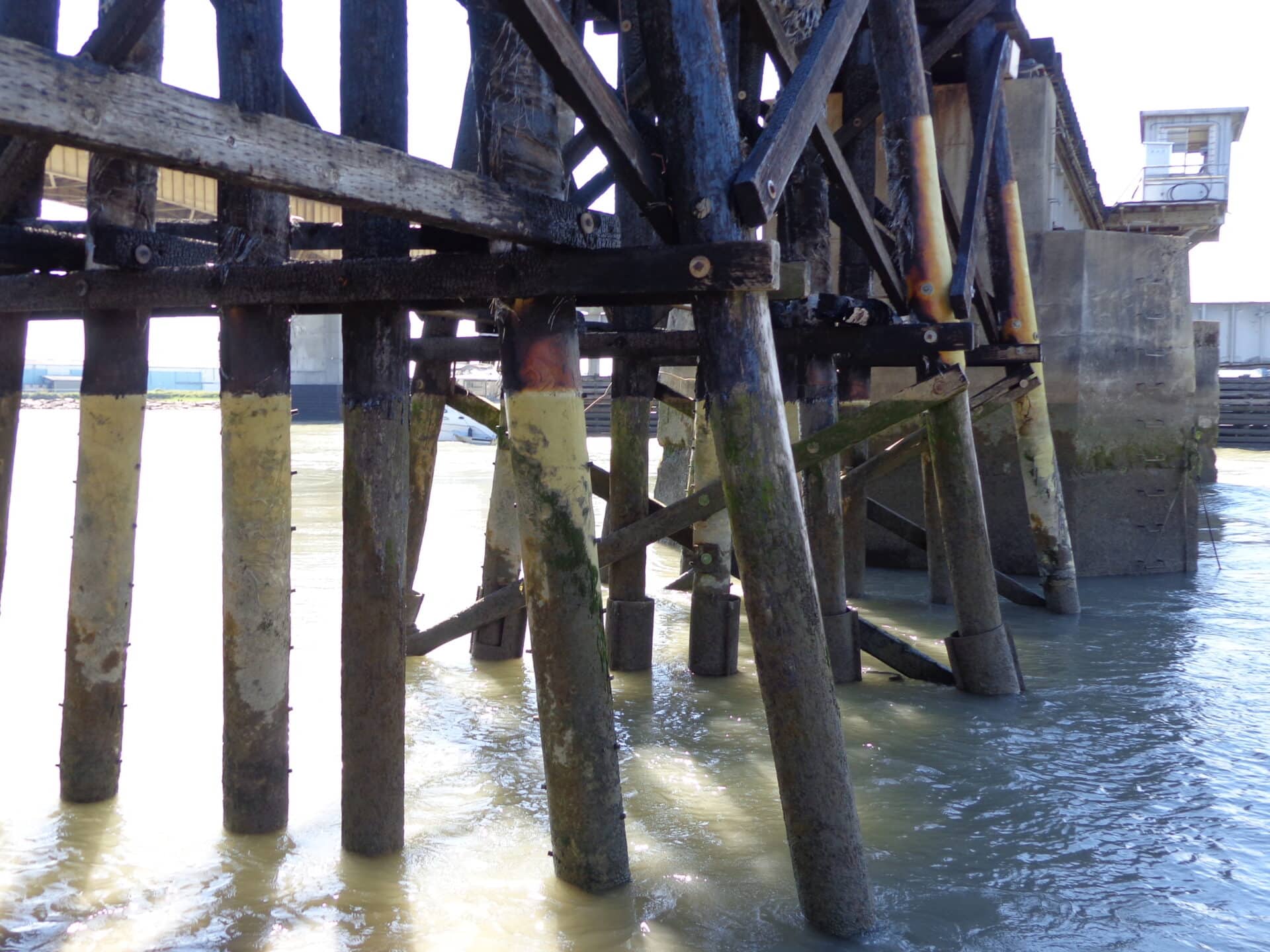
That last point matters more than it sounds. Fire frequently uncovers decay rather than causing it. A member that reads badly after a fire may have been reading badly for a decade, and the distinction changes both the repair and the question of why it happened.
Members with smoke staining and light surface browning and no measurable char have usually lost very little. That sounds obvious written down, and it is still the most common category of element to get replaced unnecessarily.
Connections are where it actually goes wrong
If a heavy timber structure is going to be unrecoverable after a fire, the connections are usually the reason.
Steel conducts heat. A steel plate, bolt or shoe in contact with timber carries heat straight into the member, and the wood immediately around the steel chars far more severely than the surrounding surface. The damage is concentrated exactly where the load is transferred and exactly where it is hardest to see, behind plates and inside recesses.
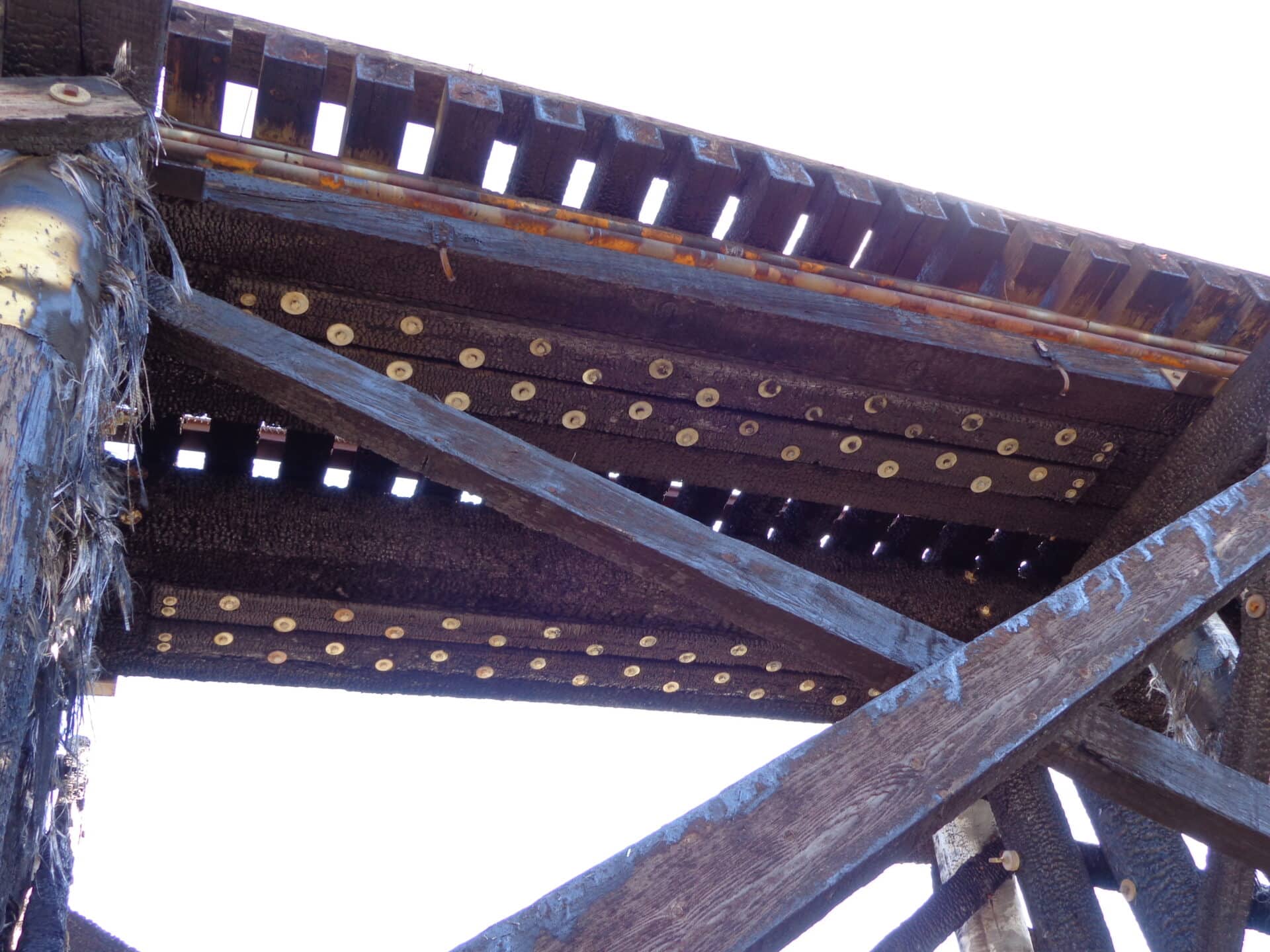
This is the same lesson that shows up in decay work. The detailing that traps moisture and the detailing that conducts heat are frequently the same detailing. Recessed steel plates, concealed connections and tight contact between materials all create conditions a designer did not intend. A post-fire inspection that looks only at the faces of members and not into the connections has not finished.
What this means for an asset owner
A fire-damaged timber structure sits in one of three states, and it is worth knowing which before the budget conversation starts.
Some structures have lost surface only and need cleaning, assessment and refinishing. Some have lost measurable section but retain enough capacity to be reinforced or rebuilt back to full design load, which is a restoration question and the subject of a companion piece on how a fire-damaged structure actually gets put back. Some genuinely are beyond recovery, and the assessment says so.
The point is that those three outcomes are distinguished by measurement, not by appearance. Writing off a structure because it looks burned skips the step that decides the answer, and that step is usually a fraction of the cost of replacement.
Before you demolish, read the wood
If you own or manage a timber structure that has been through a fire and someone has proposed demolition, get an independent, non-destructive read on the real condition first. Wood Research and Development is an accredited timber testing, inspection and engineering firm. We will tell you how much sound section is left, where it is, and what the numbers support.
The residual section is a number. Go and find it.
References
American Wood Council. National Design Specification for Wood Construction, Chapter 16: Fire Design of Wood Members. awc.org
American Institute of Steel Construction. Specification for Structural Steel Buildings, Appendix 4: Structural Design for Fire Conditions. aisc.org
International Code Council. Tall mass timber provisions, 2021 International Building Code. iccsafe.org
Canadian Wood Council. Encapsulated mass timber construction. cwc.ca
McLain, R. Repair of Fire-Damaged Mass Timber. WoodWorks, 2023. woodworks.org
USDA Forest Products Laboratory. Post-Fire Assessment of Structural Wood Members. Ross, Brashaw, Wang, White and Pellerin, 2005. fs.usda.gov