
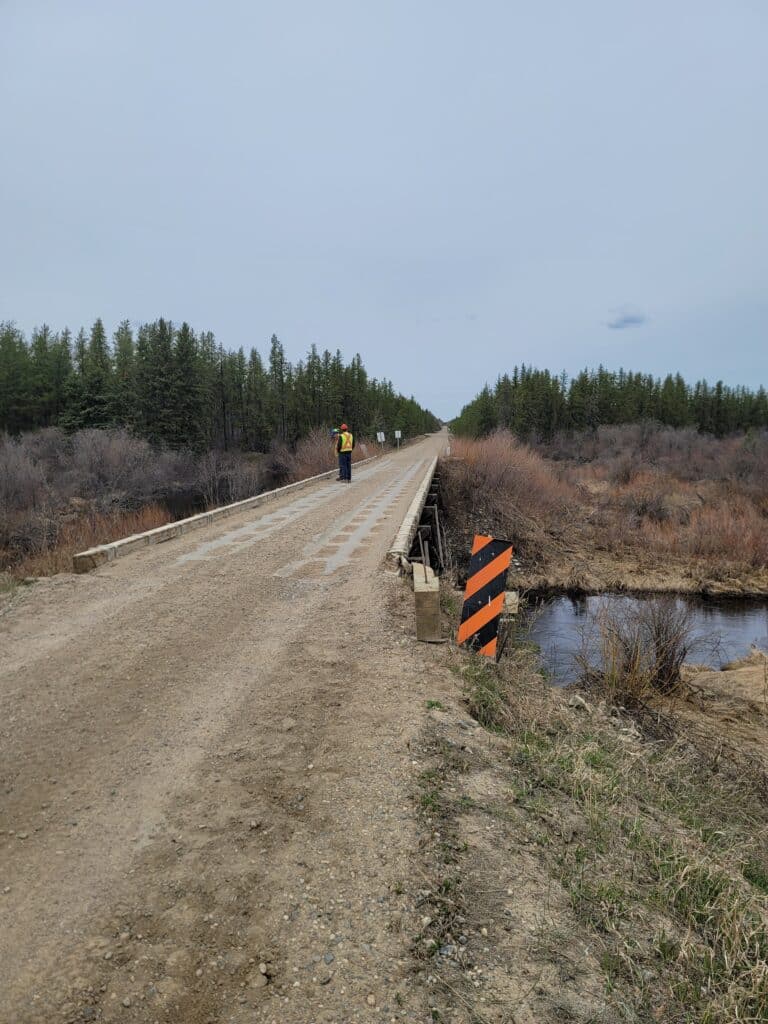
In mid-October 2016, Wood Research and Development (WRD) was commissioned by Tolko Industries to inspect one of their bridges that they had acquired from Carlton Trail Railway. This rail line had been abandoned for over 8 years. Tolko saw the potential of this abandoned rail line that would reduce some of their trucking time by 4 hours. This project required upgrading and modifying several timber railroad trestles to carry L100 log truck loads, as defined by the British Columbia Ministry of Forests.
Meadow Lake Bridge 61.4 is an eight-span timber trestle consisting of two multi-ply timber chords supported by timber pile bents. Each chord consists of 4 timber plies joined with marriage bolts; typical plies are 435mm deep and 225mm wide (nominal 10” x 18”) and continuous across two spans with staggered joints. The two outer plies (Chord 1 Ply 1 and Chord 2 Ply 4) have been replaced; they are slightly larger than the other plies at 455mm x 255mm, and have square-cut notches to make the depth at the supports match the original plies. The joint placement in Chord 1, Ply 1 does not match the original placement; instead in matches the placement of Ply 2. This means Plies 1, 2, and 4 all split at the same locations, while Ply 3 has the opposite placement. This leads to unbalanced loading in the chord, and appears to have contributed to the failure of Ply 3, where it is the only continuous ply over Bent 2.
Each bent contains 5 round piles ranging from 250 to 350mm in diameter and a sawn timber cap 335mm deep and 355mm wide. The chords support an open-tie timber deck which carried the railroad tracks; the tracks have been removed since the railroad was decommissioned. The deck was not included this inspection, as it will not be utilized in the converted structure. Due to hazardous weather conditions, portions of the bridge could not be accessed for detailed inspection and non-destructive testing.
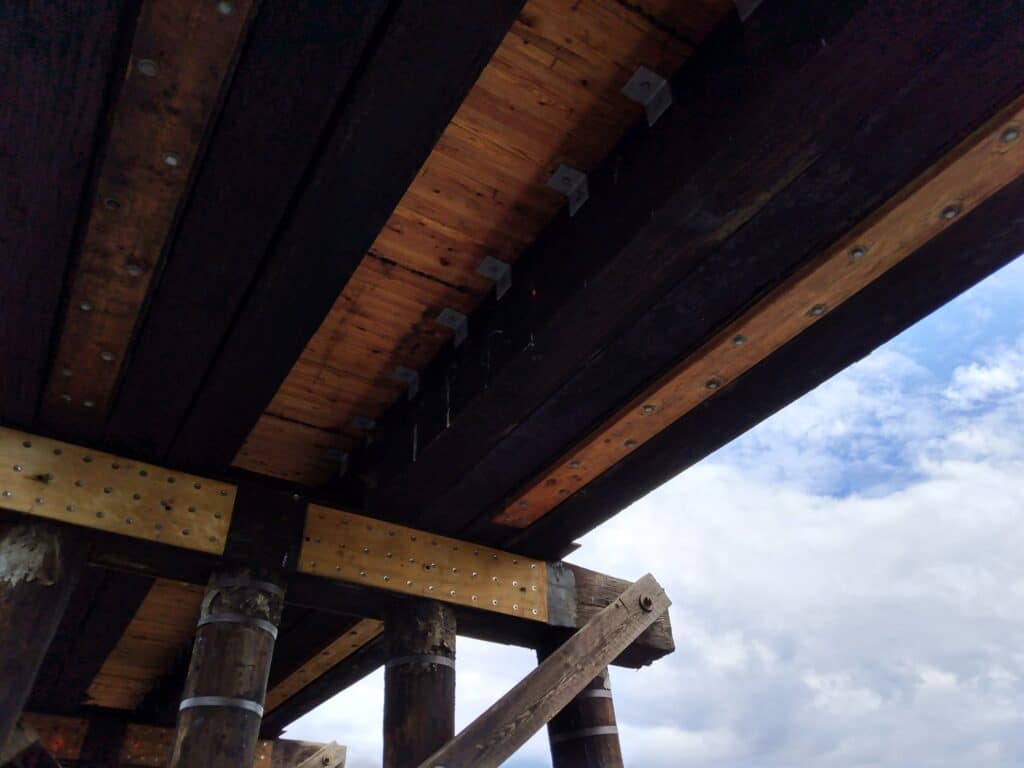
Inspection
Substructure & Chord Repair
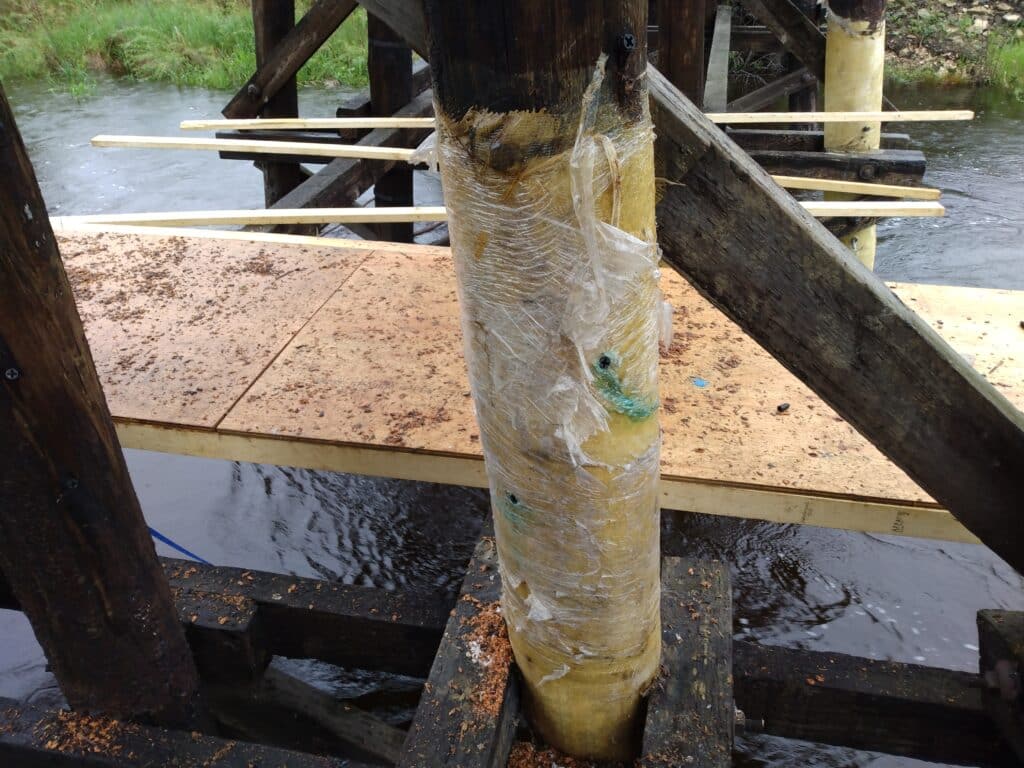
The defective piles were wrapped with high strength fiber reinforcing, and cavities were injected with high-strength epoxy filler epoxy. shear reinforcement is then added to headstock where extra strength is needed due to decay and high SWT readings in this area.
Temporary Deck Replacement
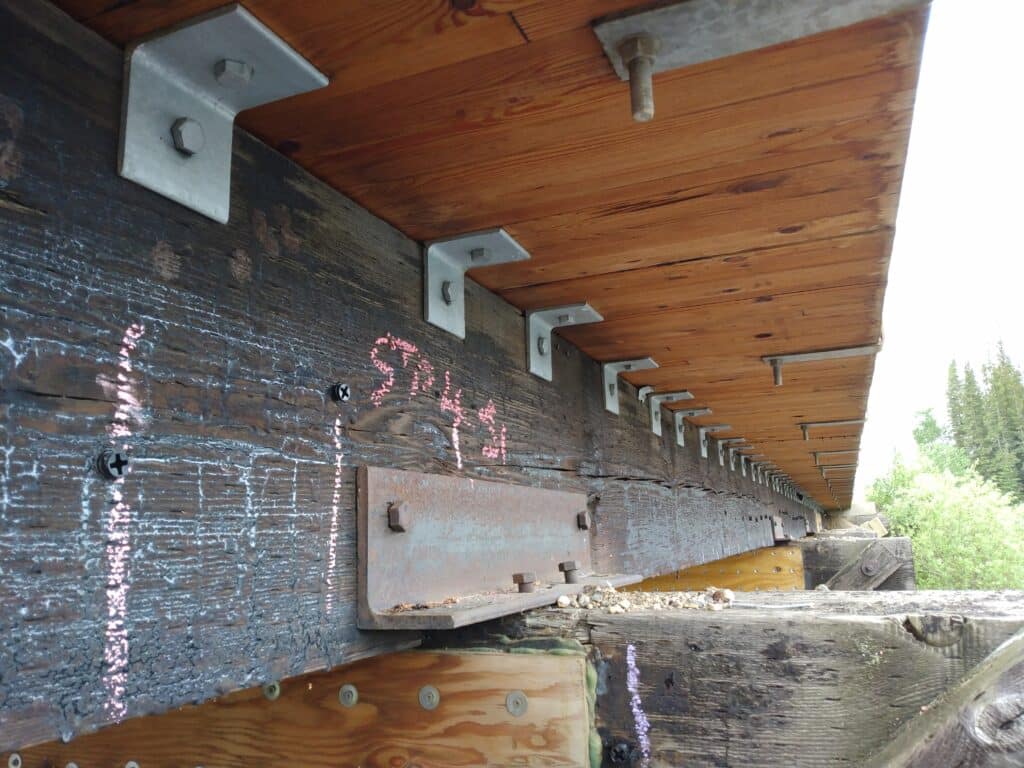
Deck Replacement
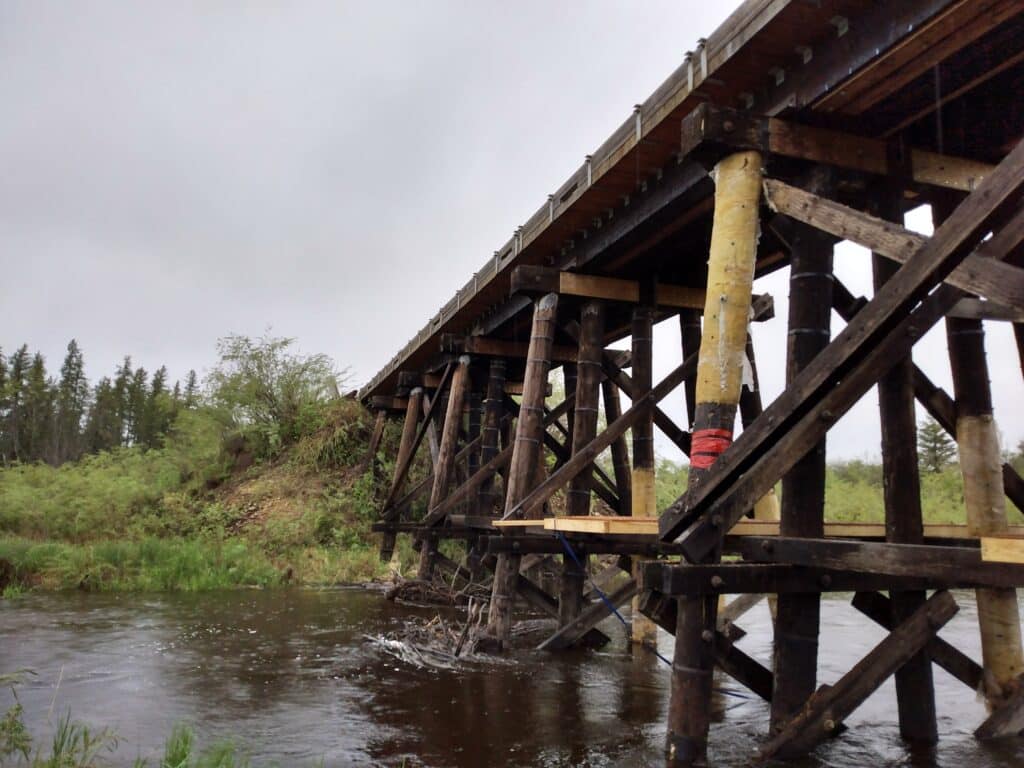
In January 2017 Timber Restoration Services took on the project of Restoring the Stringers, Caps & Piles with WRD’s repairs specifications, as seen above. The deck was to be completely replaced with a new penta treated coastal douglas fir glulam deck. The repairs completed along with the new deck have allowed this bridge to be rated for a L100 loading, which is a 100 ton rating.
Once the repairs were completed, the trucking commenced immediately. The client estimated that by using the newly repaired bridge, saving the 4 hour detour for the hauling of the logs, the company had paid for the repairs of the bridge within the first 2 weeks. You can’t do that with concrete and steel. Timber is still the way to go!