
On June 15, 2026, a standing-room-only crowd packed a Duxbury Selectboard meeting to hear a simple, expensive question answered: does the historic Powder Point Bridge need to be torn down and replaced for a projected $172 million, or can it be restored for a fraction of that?
WRD founder Dr. Dan Tingley presented the findings of an independent Level 2 timber inspection of the bridge, commissioned through the non-profit Save Powder Point Bridge and carried out under a temporary license from the town. The short version of what the data showed: roughly 90 percent of the bridge’s pile volume is still sound, the real damage is confined to a narrow tidal band, and a targeted restoration would cost less than 10 percent of a full replacement while keeping the bridge open the entire time.
The evaluation was a gift to the town, sponsored by Save Powder Point Bridge and performed by WRD as an IAS-accredited, third-party testing and engineering firm. WRD’s job was defined narrowly and honestly: establish the true condition of the bridge, produce a conditions report, and lay out what could be done about it. It was not hired to pick the town’s outcome.
WRD’s approach starts from a principle Dr. Tingley returned to all night. “We take pride in looking at a timber bridge from the inside out,” he told the board. A weathered, gray, checked pile looks finished from the outside. What matters is what the wood is doing inside, and you cannot learn that by looking, or by tapping it with a hammer.
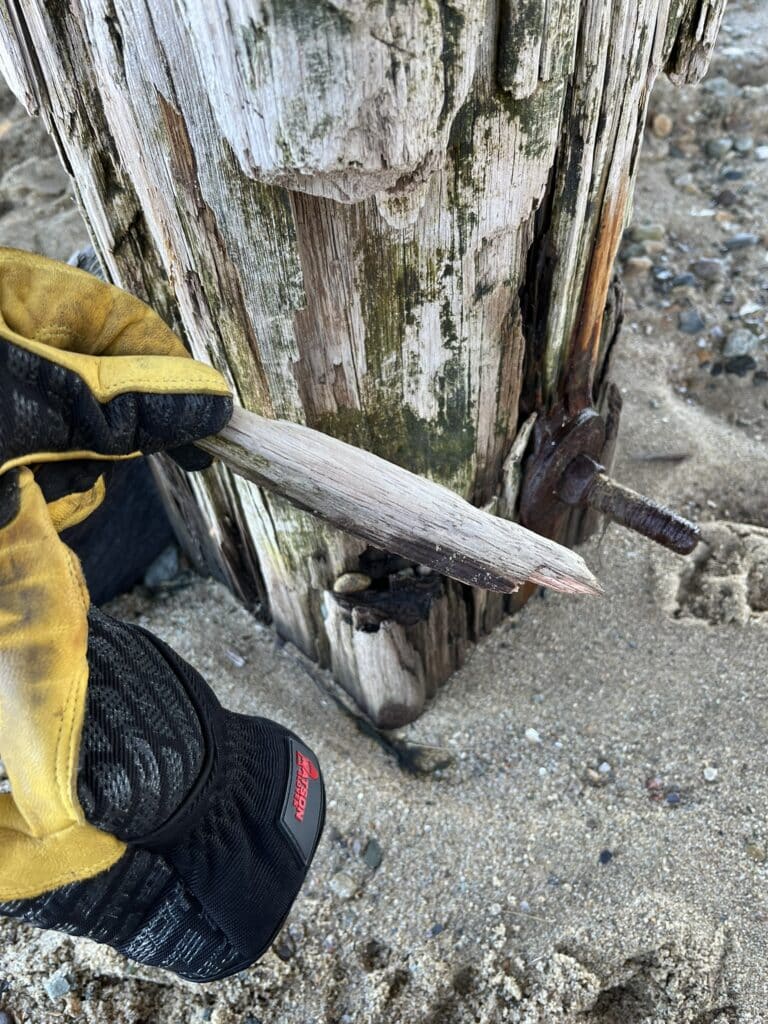
So the crew used non-destructive testing to see inside the piles: EPHOD stress-wave testing, which sends a compression wave through the wood and measures its time of flight to map internal decay, backed by PET pile-echo readings to confirm length and embedment, and resistograph micro-drilling as a cross-check. On the piles, the most vulnerable elements, WRD sampled at a 29 percent rate, far above the typical two to five percent.
The lab work went further than condition. WRD also confirmed what the bridge is actually built from, identifying the species under microscopy from their cellular structure rather than relying on records or appearance. The predominant timbers are Ekki (Lophira alata), a West African hardwood also known as red ironwood, and Angélique (Dicorynia guianensis), also called basralocus, from French Guiana and Suriname. Both are Durability Class 1 timbers with long marine records, naturally resistant to decay and to marine borers without any chemical treatment. That matters twice over. It explains why the inspection found no marine borer damage despite persistent reports of it, and it reflects a deliberate choice made in 1987, when naturally durable hardwoods were selected over the creosote-treated red oak and southern yellow pine of the 1892 bridge so that nothing toxic would enter the water the local oyster farms depend on.
That decision carried a known tradeoff, roughly 50 years of natural durability in the splash zone rather than the century that chemical treatment can deliver, on the understanding that maintenance would extend it. Reading the bridge correctly means accounting for it.
The results overturned the assumption that the bridge is failing end to end. Decay is concentrated in a narrow band roughly 3.8 feet high, in the tidal splash zone where the wood is repeatedly wetted and dried; above and below that band, the piles are largely sound. The cores of the piles, and every segment below the seabed, are intact, because below the waterline and underground there is no oxygen, and without oxygen wood does not decay.
“Every pile below the seabed is good.”
By volume, roughly 90 percent of the piles and more than 80 percent of all the wood in the structure remain serviceable. The caps and stringers came back in good condition, over 95 percent at the top rating. In plain terms, the bridge is not rotten. It has a specific, localized, well-understood problem in one tidal band, and a great deal of sound structure everywhere else.
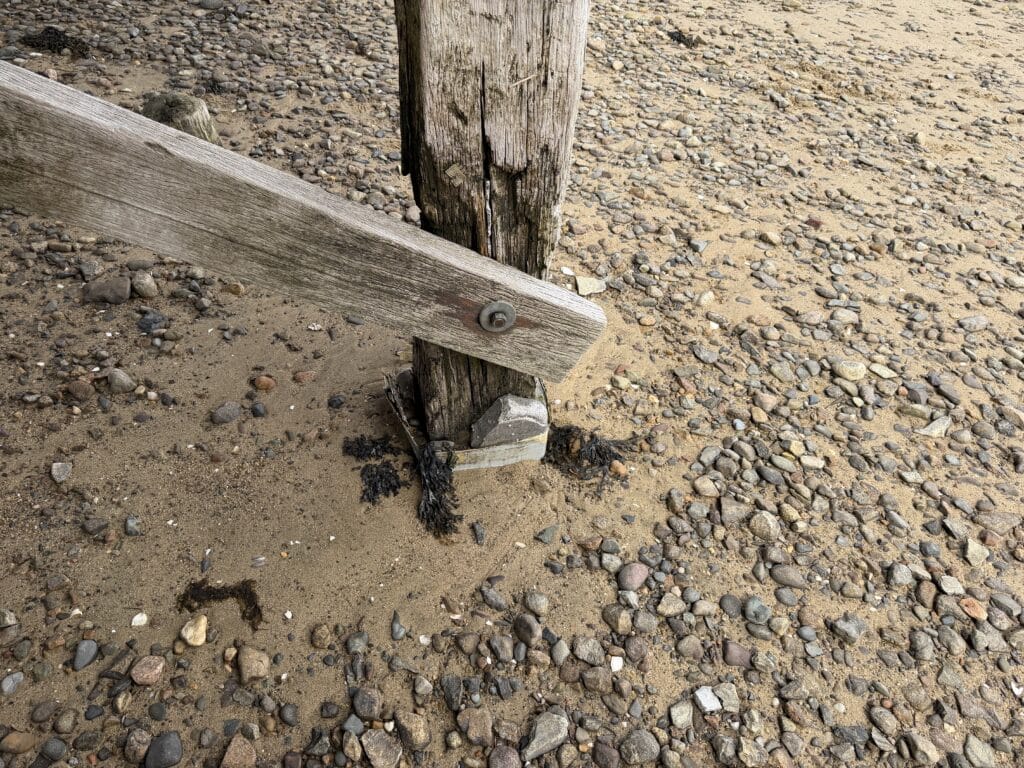
The most important finding for anyone weighing the bridge’s future is what happened to the fiber-reinforced polymer wraps and grout installed around the piles about a decade ago. They were meant to protect the piles. The inspection data shows they accelerated the damage instead.
The mechanism is physics, not blame. Timber draws in moisture and swells. A dense hardwood pile wrapped tightly and grouted has nowhere to expand, so the swelling generates enormous internal hoop stresses, on the order of 64,000 psi, far beyond what the wrap could contain. The result was cracked wrapping and crushed outer wood fiber, which then decayed faster than the unwrapped piles nearby. WRD’s stress-wave data made the pattern statistically clear: the wrapped piles in the splash zone were, on average, in worse condition than the ones that were never wrapped.
“The best thing you could do for those wraps right today for that bridge, take them all off.”
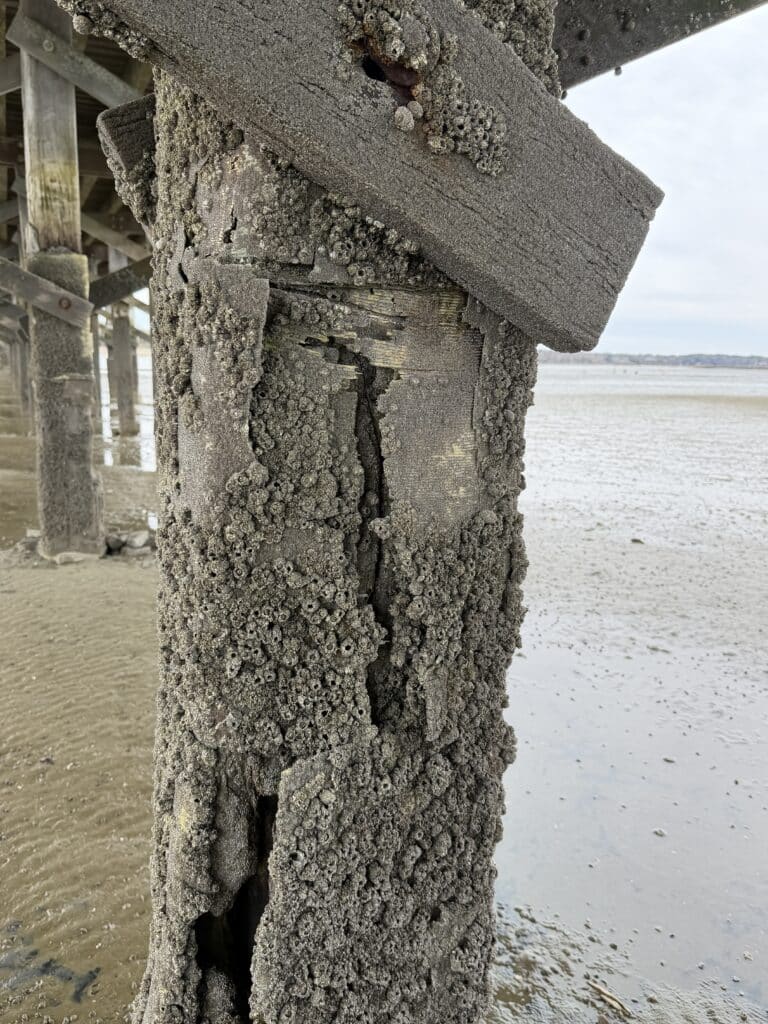
Because the damage is localized, the repair can be too. WRD laid out proven, non-proprietary restoration methods drawn from accepted standards. Where a pile’s core is still sound, a Dutchman’s patch keeps that core and replaces only the decayed outer shell in the splash zone, so from the outside the pile looks exactly as it did before. Where the core itself was split by earlier bracing failures, segment posting with fixed-end-moment connections rebuilds the pile section and restores its full strength, effectively simulating a new pile. Alongside this, the cross-bracing that provides the bridge’s lateral stability would be reinstated, which matters because at this bridge the governing loads are ice and lateral flow, not vehicle weight.
Done this way, the bridge’s overall condition rating could be brought from its current 3 back to a 1 or 2, restoring and even improving load capacity. Rating 1 indicates like-new condition and is free of defects, Rating 2 is Fair with minor deterioration, and Rating 3 is Poor with deterioration requiring attention. Critically, none of these methods require closing the bridge to traffic during construction. That single fact carries enormous weight against the alternative.
Here is the number that reframes the whole decision. The state’s replacement project is budgeted at roughly $172 million. WRD’s estimate to address the urgent piles, the roughly 310 in the priority splash zone, plus the cross-bracing, is on the order of $3.1 million. A full restoration of the entire bridge, phased over several years, would run up to about $17 million. That upper figure is less than 10 percent of the cost of replacement.
And the money to do it may already be on the table. Of the roughly $172 million, about $114 million comes from the federal Bridge Formula Program, with the rest from the Surface Transportation Block Grant, and neither is replacement-only money. As funding specialist Maghan Barber explained at the hearing, the Bridge Formula Program
“funds repair, rehabilitation, preservation, not just building new. Those same program funds could support a rehabilitation instead of a full replacement.”
Where the state route is not available, she noted, a town can apply directly to the Federal Highway Administration’s Bridge Investment Program for up to 80 percent of an alternative project’s cost.
There was also a jurisdictional green light. Paul Brogna, vice chair of the town’s bridge advisory committee and a licensed civil engineer, reported that the state confirmed it would not block a wooden-bridge restoration provided a Massachusetts-licensed engineer stamps the designs and oversees construction. A restoration is not just cheaper. It is permissible.
Weigh the two paths honestly. Replacement: $172 million, a projected multi-year closure, and the loss of a historic structure. Restoration: as little as $3.1 million now and up to roughly $17 million for the full job over time, with the bridge open throughout and its character intact.
“Why would we throw the baby out with the bathwater?”
Powder Point is a vivid example of a pattern WRD sees everywhere. Timber bridges are routinely written off on the strength of a surface look, an incomplete inspection, or a repair that treated the symptom instead of the cause. The assumption that timber does not last is simply not borne out by the data. The average timber bridge in Massachusetts is older than the average steel or concrete one.
There is also a carbon argument that is easy to miss. The Powder Point Bridge holds roughly 1,000 tons of embodied carbon. Wood sequesters carbon rather than emitting it, while steel and concrete are net emitters in manufacture. Keeping and restoring a sound timber structure is not only the cheaper decision, it is often the greener one.
None of this means every timber bridge should be saved. It means the decision should be made on evidence read from the inside out, not on appearance. That is the entire point of an accredited, non-destructive inspection: to separate real structural loss from cosmetic weathering before a community commits tens or hundreds of millions of dollars.
AT A GLANCE
| Structure | Powder Point Bridge, Duxbury, Massachusetts. A timber trestle crossing first built in 1892 and reconstructed in durable hardwoods in 1987. |
|---|---|
| Engagement | Independent Level 2 timber inspection and conditions report, sponsored by Save Powder Point Bridge. |
| Methods | EPHOD stress-wave testing, PET pile-echo testing, resistograph micro-drilling, species and moisture testing, 29% pile sampling. |
| Key findings | About 90% of pile volume and more than 80% of all timber serviceable; decay confined to a ~3.8 ft splash zone; cores and below-seabed sections sound; 2013 wraps found to accelerate decay. |
| Proposed remedy | Dutchman's patches, segment posting with fixed-end-moment connections, cross-bracing reinstatement. No bridge closure required. |
| Cost context | About $3.1M for priority splash-zone piles; up to ~$17M for full restoration, under 10% of the ~$172M replacement. |